
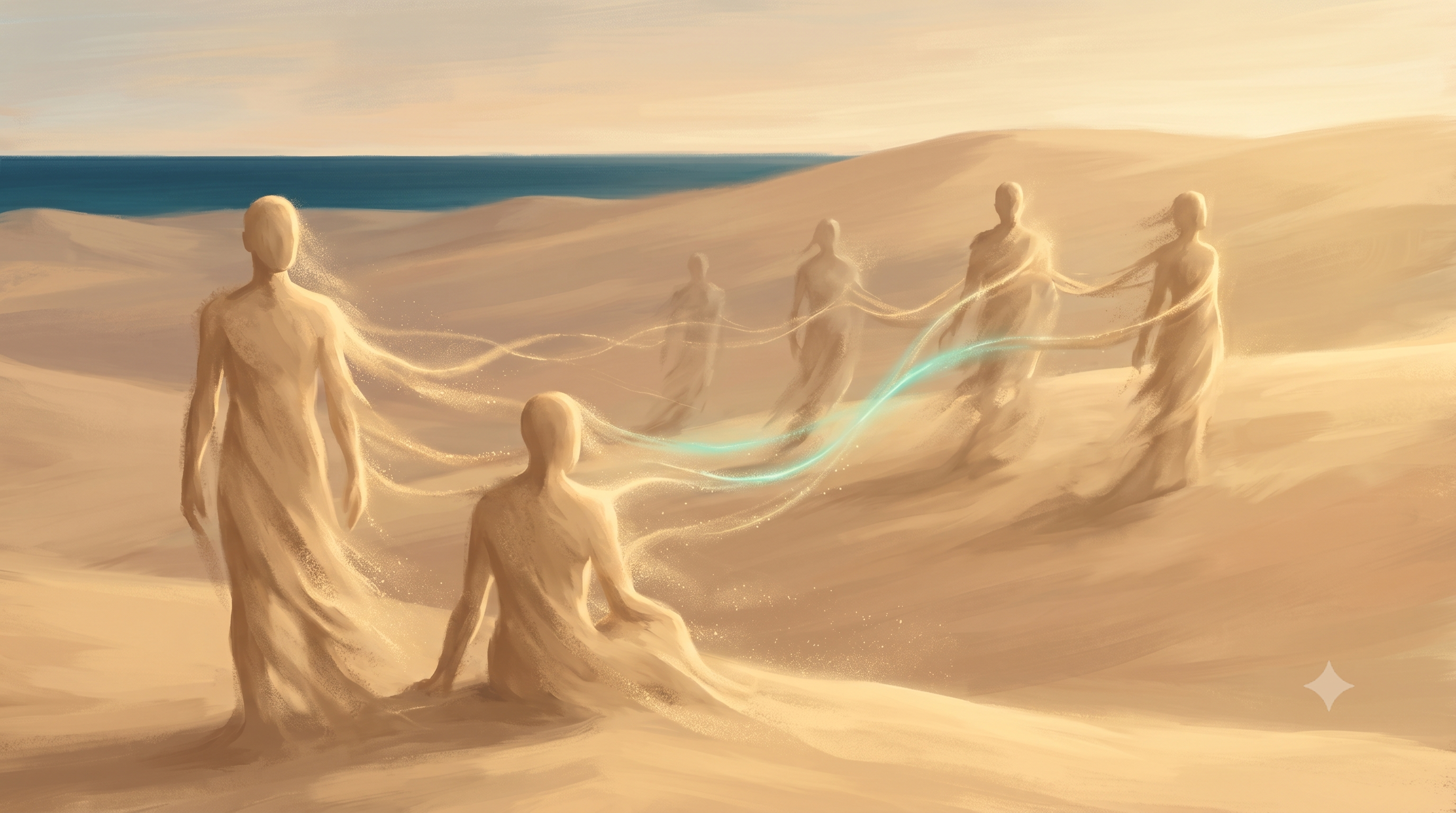
A patient sits across from me in the clinic, holding their cup of tea tightly, hand trembling, feeling that everything in their life is fine — and yet everything is falling apart. He tells me that his life looks perfect on paper. He has the career. He has the family. He has the stable income. He did everything society expected of him. But for the past three weeks, reality feels incredibly fragile to him. He describes a physical sensation of dissolving. He says he feels terrified because the person he thought he always was is slipping away, leaving him standing over a terrifying void. He asks me if he is going crazy. I look at him. I notice his shallow breathing, his shoulders drawn in. I realize he is not broken. He has simply reached the edge of his ego. The usual boundary of his self is thinning.
The question of what transpersonal psychology is is really the question of what human consciousness is. The term transpersonal means beyond the personal. When my client feels himself dissolving, classical psychiatry might rush to pathologize the experience. A conventional clinic might label it dissociation, a depressive break, or a severe panic disorder. The immediate reflex is often to medicate the anxiety and restore the person to his previous state of functioning. But there is another way to look at this fragility. Sometimes the edge of the ego thins not because a person is sick, but because the container of his current identity has become too small. He is experiencing a crisis of growth, not a crisis of collapse.
The Four Forces of Psychology
To understand how psychology arrived at this specific point, it helps to look at the history of the field. Psychology developed in distinct waves, often called the four forces. Each force answered a specific question about human nature, and each force built the necessary foundation for the next.
The first force was psychoanalysis. Sigmund Freud and his contemporaries mapped the dark basement of the human mind. They looked at repressed drives, childhood wounds, and the unconscious forces that dictate behavior. Psychoanalysis gave psychology immense depth, but it was heavily focused on pathology. It viewed the human being as a closed system constantly defending itself against its own dark impulses. The goal was to bring the unconscious into consciousness, but the overarching view of human nature was fundamentally pessimistic. The ego was seen as a fragile manager trying to keep chaotic biological drives under control, and nothing more.
The second force was behaviorism. Thinkers in this school stepped entirely away from the invisible unconscious. They focused strictly on what could be measured and observed in a laboratory. They looked at conditioning, reward, and punishment. Behaviorism treated the human being almost like a complex biological machine. If you change the environmental inputs, you change the behavioral outputs. This force offered excellent clinical structure and measurable results, but it completely ignored the inner life, the emotions, and the soul of the individual.
The third force emerged in the middle of the twentieth century as a direct rebellion against the first two. Humanistic psychology rejected the idea that humans were just broken machines or animals driven by base instincts. The humanistic approach focused on potential. It introduced the idea that people have an innate, healthy drive toward self-actualization. It brought warmth, empathy, and dignity back into the clinic. The therapist was no longer a cold blank slate sitting behind the patient, but a genuine human presence at eye level. Depth without structure collapses, but structure without depth simply dries out.
But even the humanistic approach had a ceiling. It focused entirely on the individual self and the fulfillment of personal desires. By the late nineteen sixties, a growing group of psychologists realized that human experience simply does not end at the boundary of the individual personality. There are states of consciousness that go far beyond the personal ego. In 1968, these thinkers came together and formally declared the Fourth Force. They called it transpersonal psychology.
The Spiritual Dimension
Transpersonal psychology acknowledges everything the first three forces built. It respects the power of the unconscious mind. It understands behavioral conditioning and the way the human brain learns. It deeply values individual potential. But it adds a dimension that the others left entirely out. It adds the spiritual dimension.
This approach looks at the human being as a complete ecosystem of body, mind, and soul. It suggests that psychological growth is not only about repairing what broke in childhood or resolving a temporary crisis. Real growth is a movement beyond the ego. In classical medicine, the goal is often to build a strong, well-adjusted ego so a person can function smoothly in society. That is absolutely vital work, since a person cannot transcend an ego he has not yet built or stabilized. But transpersonal psychology asks what happens after that ego is built and established. Does a person simply maintain and patch it until he dies? Or is the ego merely a vehicle meant to take him somewhere else entirely, somewhere broader and deeper? The understanding here is that the ego is a developmental stage, not our final destination.
Spiritual Emergency or Mental Illness
This brings me back to the man in my clinic holding his coffee cup. He feels like he is falling apart. The transpersonal framework offers a crucial distinction here that changes the entire picture. It is the sharp distinction between a spiritual emergency and a mental illness. A spiritual emergency is in fact a spiritual awakening. It happens when the edge of the ego thins too rapidly. A person might suddenly experience a flood of profound existential insights, a sudden and devastating loss of meaning in a life that once satisfied him, or a terrifying sense of connection to everything around him to the point of losing his sense of boundaries. His nervous system is flooded with far more reality than his current psychological structure can hold in that moment.
Without the right framework, this experience looks exactly like a psychological breakdown. The person might stop sleeping well, feel entirely overwhelmed by the suffering of the world, or question his entire reality. Conventional medicine often meets this crisis with medication and a diagnosis of pathology, with the goal of silencing the symptoms as quickly as possible. But the transpersonal therapist asks a different question. He examines whether this breakdown is actually a breakthrough. Is the shell breaking because the chick is ready to emerge? If a person is experiencing a spiritual emergency, the work is not to suppress the experience or shut it down out of fear. The work is to help him navigate it safely. I provide structure, grounding, and an anchor while the client integrates this new awareness into his nervous system. The edge of the ego is a difficult, dizzying place to stand. It requires a guide who knows the terrain and understands that not all pain is sickness.
The Minds Who Mapped the Terrain
The psychological terrain was mapped by brilliant minds who dared to look beyond the conventional limits of science at the time. Stanislav Grof is one of the most central figures in this history. Grof was a trained Freudian psychiatrist who grew up from within the very heart of the medical establishment. He began his career with legal psychiatric research on LSD in safe clinical settings, observing how non-ordinary states of consciousness allowed patients to access deep, buried traumas that no psychoanalytic conversation had ever been able to touch, and to experience profound spiritual insights of connection. When the chemical route was restricted and prohibited by governments, Grof did not stop his research. He understood that the substance itself was not the point, it was the state of consciousness. He then developed Holotropic Breathwork. He discovered that sustained accelerated breathing could lead people into those exact same non-ordinary states of consciousness without any external substance. This discovery is directly tied to the rebirthing facilitation I practice today. The breath itself becomes the tool through which we reach the edge of the ego and bypass the cognitive gatekeeper.
Abraham Maslow also pushed the boundaries of the field to establish the Fourth Force. While he is famous for his hierarchy of needs in the humanistic tradition, his later and more mature work focused intensely on what he called peak experiences. He studied those rare, spontaneous moments of awe, unity, and deep connection that people experience in nature, in art, or in deep meditation. Maslow recognized that these moments are not neurological anomalies or an escape from reality. They are glimpses of human reality operating at its highest and healthiest potential.
Viktor Frankl brought another vital layer to this work. Frankl survived the horrors of the Holocaust and observed, from the darkest possible abyss, that those who found meaning in their immense suffering were the ones with the highest chances of psychological and physical survival. But he taught something even deeper than that. He showed that meaning is never found by focusing endlessly on the self and its needs. Meaning is found through self-transcendence. It arises when a person dedicates himself to a cause, a creation, or a love that lies entirely outside his private ego. The ego finds its rest only when it serves something larger than itself.
Carl Jung is often considered the first Western transpersonal psychologist, despite working decades before the movement received its formal name. Jung understood and argued that the goal of life is not just to fix childhood neuroses or become a socially adapted citizen. He saw a process he called individuation, a continuous growth toward ever higher levels of consciousness across the full arc of a life. Jung knew that the psyche contains an authentic spiritual drive that is just as real and just as urgent as our biological drives for survival and reproduction. To ignore the spiritual drive, or to pathologize it, is to invite illness and neurosis.
In the Israeli academic and clinical context, this work has strong and important anchors. Dr. Maty Lieblich explored this space comprehensively in her 2009 work, At the Edge of the Ego. She examined the deep and delicate meeting point between contemplative traditions from the East and clinical psychology from the West. This East-meets-West thesis is the very heartbeat of the transpersonal work I bring into the clinic. It takes the clinical precision, structural safety, and psychological understanding of the West and connects it to the ancient, vast, and time-tested spiritual maps of the East.
Buddhism and Non-Self
Because you cannot truly speak about the edge of the ego, about dissolution and reconstruction, without speaking about Buddhist philosophy. Buddhism offers one of the most precise maps of human consciousness ever created, long before Western psychology existed. At the very heart of Buddhist teaching is the concept of anatta, meaning non-self.
Buddhism points to the fact that the isolated, fixed self we are so certain about is, at its core, an illusion, the illusion of separateness. Human beings suffer deeply because they believe they are completely cut off and separate from the world around them. From within this experience of disconnection, they spend most of their lives building thick protective walls around this fragile identity, obsessively defending against anything perceived as threatening to the ego. They chase degrees, financial achievements, social status, and relationships, all in order to fortify and strengthen this constructed self so it feels protected. But the transpersonal approach, drawing deeply from Buddhism, understands that the ego and this rigid sense of separateness are only developmental stages on the way to a greater awakening.
When a client settles into the therapy chair, or when he breathes deeply on a mat during a rebirthing session, the edge of the ego begins to thin. The armor cracks. He begins to have the direct experience that the boundary between himself and the world is not actually sealed, it is completely permeable. The rigid separation between inside and outside, between self and other, begins to dissolve into a deep sense of unity and a wide web of interdependence.
This understanding can be an enormous liberation, and at the same time terrifying at first, or more precisely, it is usually terrifying at first. This is exactly why these delicate transitions must always rest on a broad and stable foundation of compassion. The transpersonal therapist must know how to hold a space. If a person experiences the dissolution of the ego without first building a foundation of deep compassion for himself and for the world, he will simply have no inner support to hold onto as the walls come down. He will feel he is falling into a black existential void rather than expanding into luminous space. The holding therapeutic presence acts as solid and safe ground precisely in those moments when the usual identity falls away. We do not need to become someone else in this process. We need to remove what is blocking the essence of who we already are.
What This Looks Like in Practice
So what does all this philosophy and theory actually look like in practice, inside a therapy room? When a client walks into my clinic, he does not receive an intellectual lecture on Buddhism or the history of psychology. He receives a structured, safe, and grounded process. Working in the transpersonal approach means I assemble and use an expanded toolkit that relates to the whole human system rather than just the speaking mind.
Talk therapy is a classic and very powerful therapeutic tool, but in various situations it often leaves the client trapped inside the loops of the intellect. The intellect and rationalization are the ego's favorite playground. That is where it rules. The ego loves to analyze, to tell itself justifying stories, and to endlessly defend its position. To reach the deeper layers of consciousness, to the root wounds that run behavior, the therapeutic process must at some point bypass these cognitive defenses.
I do this in the clinic through somatic, bottom-up work. Rather than trying to understand the problem through the head in order to calm the body, we work with the body in order to open the head. I might guide a client through sustained conscious breathing, physical movement for release, or work with deep mindfulness states. As the client enters those non-ordinary states of consciousness, the rigid defenses gently and safely release their grip. The usual boundary of the self thins naturally. In that open, non-linear space, the client can access suppressed emotions blocked in daily life, forgotten physical memories locked in the tissue, and a direct, profound sense of connection. The therapy becomes a living, breathing somatic experience in real time, not merely an intellectual conversation analyzing events from the past.
It is important to recognize that this is a fully established, rigorous, and academically recognized discipline. It is not a fringe movement, a new age trend, or something disconnected from clinical reality.
Sofia University in California founded the very first comprehensive master's degree in this specific field of transpersonal psychology. Naropa University in Colorado has for years offered deep Buddhist-inspired clinical training that integrates spiritual traditions into conventional therapeutic models. The Centre for Counselling and Psychotherapy Education in London has been training transpersonal practitioners since 1984 and holds official recognition from leading psychotherapy organizations since 1991.
Who This Approach Is For
Who is this approach actually for? It is certainly not for everyone at every moment in their journey. If a person is in an acute psychiatric crisis, lacks basic ego strength, or is genuinely struggling to function in daily reality and regulate himself, he first and foremost needs traditional grounding, clinical stabilization, and perhaps pharmacological support. Again, a person cannot transcend an ego he has not yet built or stabilized.
But for the emotionally intelligent, self-aware, and sensitive adult who may have already done conventional therapy and still feels a deep inner emptiness that has no name in classical medicine, this work is critical for the next breakthrough. This approach is for the person dealing with profound existential confusion, severe burnout despite external success, or a sudden crisis of meaning in midlife. It is for the individual who senses, deep in their gut, that their depression or anxiety is not just a collection of symptoms or a mere chemical imbalance, but a strong signal from a soul suffocating inside a life that has grown too narrow and too small. It is of course also for therapists and group facilitators who genuinely want to expand their inner capacity to safely hold the vast depths of human suffering, and alongside it, the moments of awakening and healing.
In the end, the transpersonal current claims no new psychological inventions from scratch. It simply connects with wisdom what already exists. It bridges with humility the perennial philosophy and ancient wisdom of contemplative traditions across human history with the clinical precision, structure, and safety of contemporary modern psychology. This current recognizes that beyond biology and patterns of thought, human beings are vast, extraordinarily complex creatures, deeply connected to the whole fabric of reality.
When I sit with a client in the clinic, as he confronts his deepest fears and holds his cup of tea trembling in his hands, I do not see a broken biological machine that needs fixing or re-tightening of screws. I see a whole and courageous human being navigating the incredibly difficult terrain of human consciousness. At the center of this therapeutic work always stands the client, and the deep conviction that the truth of his healing is a truth he already holds within him, and has for a long time. My role as his therapist is not to plant ideas in him from the outside, but simply to gently help him clear the debris that has accumulated over the years, so that he can finally hear that truth himself.
The edge of the ego, that place that feels so fragile and frightening at first, becomes a quiet, wide, and possibility-filled place the moment we stop fighting it. The fear simply falls away, slowly. And then you understand that you are not really dissolving into anything. You are simply expanding, gently, into everything else.