
Synergistic Integration: Theoretical Map Meets Hospital Validation
The convergence of transpersonal psychology and conventional hospital psychiatry is exemplified by the synergistic contributions of Dr. Stanislav Grof and Dr. James Eyerman. Dr. Grof provided the theoretical architecture—mapping the human psyche beyond biographical boundaries into perinatal and transpersonal domains through Holotropic Breathwork (HB). Dr. Eyerman delivered unprecedented empirical validation through a continuous 12-year clinical study of over 11,000 psychiatric inpatients in a community hospital setting, establishing HB as a low-risk, high-reward modality for refractory trauma, addiction, and mood disorders.
Explore Synergistic Roles
Toggle between the foundational theoretical architect and the clinical research validator.
Contains conscious and unconscious memories from infancy through adulthood. Traditional psychoanalysis operates almost exclusively here. HB accesses this layer to discharge repressed emotional trauma.
Centers on biological birth memories stored in the somatic network. Divided into 4 Basic Perinatal Matrices (BPM I-IV), reflecting intrauterine bliss, contraction without exit, active birth struggle, and emergence.
Transcends individual ego, space, and time. Features mythopoetic encounters, ancestral re-experiencing, unitive states, and direct contact with a "Higher Power" that restructures self-identity.
Grof's Cartography & The Basic Perinatal Matrices (BPMs)
Following early LSD research at the Maryland Psychiatric Research Center, Dr. Stanislav Grof observed that psychological distress often originates far deeper than early childhood memories. He mapped the human unconscious into three distinct tiers and formulated the Basic Perinatal Matrices (BPMs) and Systems of Condensed Experience (COEX), explaining how physiological birth trauma creates a permanent somatic template for adult psychiatric illness.
Interactive Perinatal Matrix (Click a Stage to Explore)
COEX System Simulator (Systems of Condensed Experience)
A COEX system is an unconscious constellation of memories sharing similar emotional or physical themes. Select a clinical symptom to trace how adult triggers connect down through childhood events to foundational perinatal roots.
Dr. James Eyerman's 12-Year Landmark Hospital Study
While Dr. Grof constructed the transpersonal cartography, Dr. James Eyerman provided its definitive clinical validation. Over a continuous 12-year period at St. Anthony’s Medical Center (St. Louis, MO), Eyerman evaluated over 11,000 psychiatric inpatients undergoing Holotropic Breathwork. His findings established an unprecedented statistical safety profile (zero severe adverse events) and documented remarkable recovery rates among patients with refractory trauma and substance dependence.
Phenomenological Content Distribution (n=482 Cohort)
Percentage of inpatients reporting specific non-ordinary experience categories during HB.
Long-Term Addiction Abstinence Outcomes
Documented complete abstinence ranges (2–19 years) following adjunctive HB therapy.
Documented Clinical Case Vignettes (Eyerman & Brewerton)
Filter real inpatient case histories by primary clinical pathology.
Physiological Cascades & Psychological Mechanisms
Inducing expanded states of consciousness through voluntary hyperventilation operates via distinct physiological and neurobiological pathways. Controlled voluntary breathing shifts blood pH, alters cerebral blood flow, and quietens cortical control centers, facilitating the somatic extinction of conditioned fear responses (Rhinewine & Williams, 2007).
Interactive Cascade of Physiological Mechanisms
Evocative Music Arc
Functions as the non-pharmacological "dosage." Carefully structured music drives emotional depth, encouraging breakthrough without verbal therapist interference.
Breather / Sitter Dyad
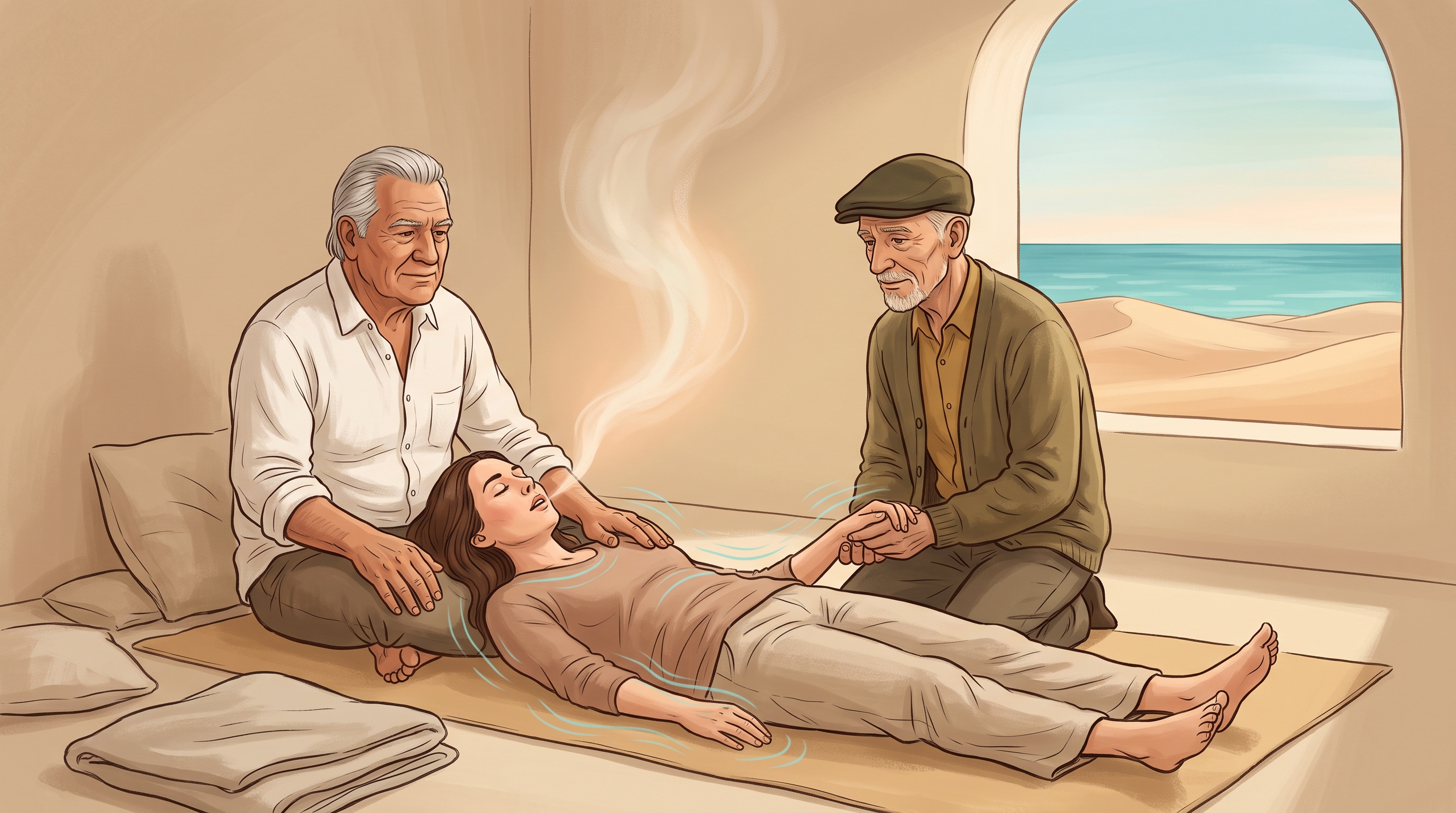
Patients alternate roles. The sitter provides non-judgmental presence and physical containment, eliminating safety anxiety for the breather.
Focused Somatic Bodywork
Facilitators apply firm resistance to body areas holding tetanic tension, giving the patient a physical boundary to push against and resolve blocked Gestalts.
Standardized Inpatient Session Format & Integration
To integrate Holotropic Breathwork into a conventional acute psychiatric hospital, Dr. Eyerman standardized a 2-hour group format. This structured sequence ensures patient preparation, safe somatic emotional release, non-verbal expression via mandalas, and strict non-analytic group sharing.
2-Hour Standard Inpatient Group Timeline
Clinical Preparation & Orientation
Facilitator frames potential experiences across sensory, biographical, perinatal, and transpersonal domains to normalize symptoms.
Accelerated Circular Breathwork & Music Arc
90 minutes of continuous hyperpnea accompanied by an escalating evocative music arc. Active somatic processing and emotional catharsis.
Mandala Drawing (Non-Verbal Integration)
Immediate expression using pastels/markers inside a pre-drawn circle, bypassing left-hemisphere cognitive intellectualization.
Group Sharing & Epistemic Hygiene
Phenomenological sharing. Facilitators enforce non-analytic, non-interpretive witnessing to preserve patient authority over meaning.
The 90-Minute Evocative Music Arc (Dynamic Dosage)
Trajectory of musical intensity driving psychological depth.
Publications, Contemporary Applications & Psychedelic Research Synergy
The work of Dr. Grof and Dr. Eyerman directly underpins modern psychedelic-assisted psychotherapy protocols. Organizations like MAPS (Multidisciplinary Association for Psychedelic Studies) explicitly incorporate Grofian principles—such as the Inner Healing Intelligence, non-directive facilitation, and evocative music dosing—into MDMA Phase 3 clinical trials for severe PTSD.
MAPS Protocol & Holotropic Breathwork Synergy
Both MAPS MDMA protocols and HB reject therapist interpretation, trusting the patient's intrinsic psychological capacity to select and heal trauma.
The official MAPS PTSD trial manual recommends Holotropic Breathwork as a viable non-pharmacological alternative when psychedelics are medically contraindicated.
Key Bibliography & Publications
Search and filter major books, clinical trials, and theoretical papers.